
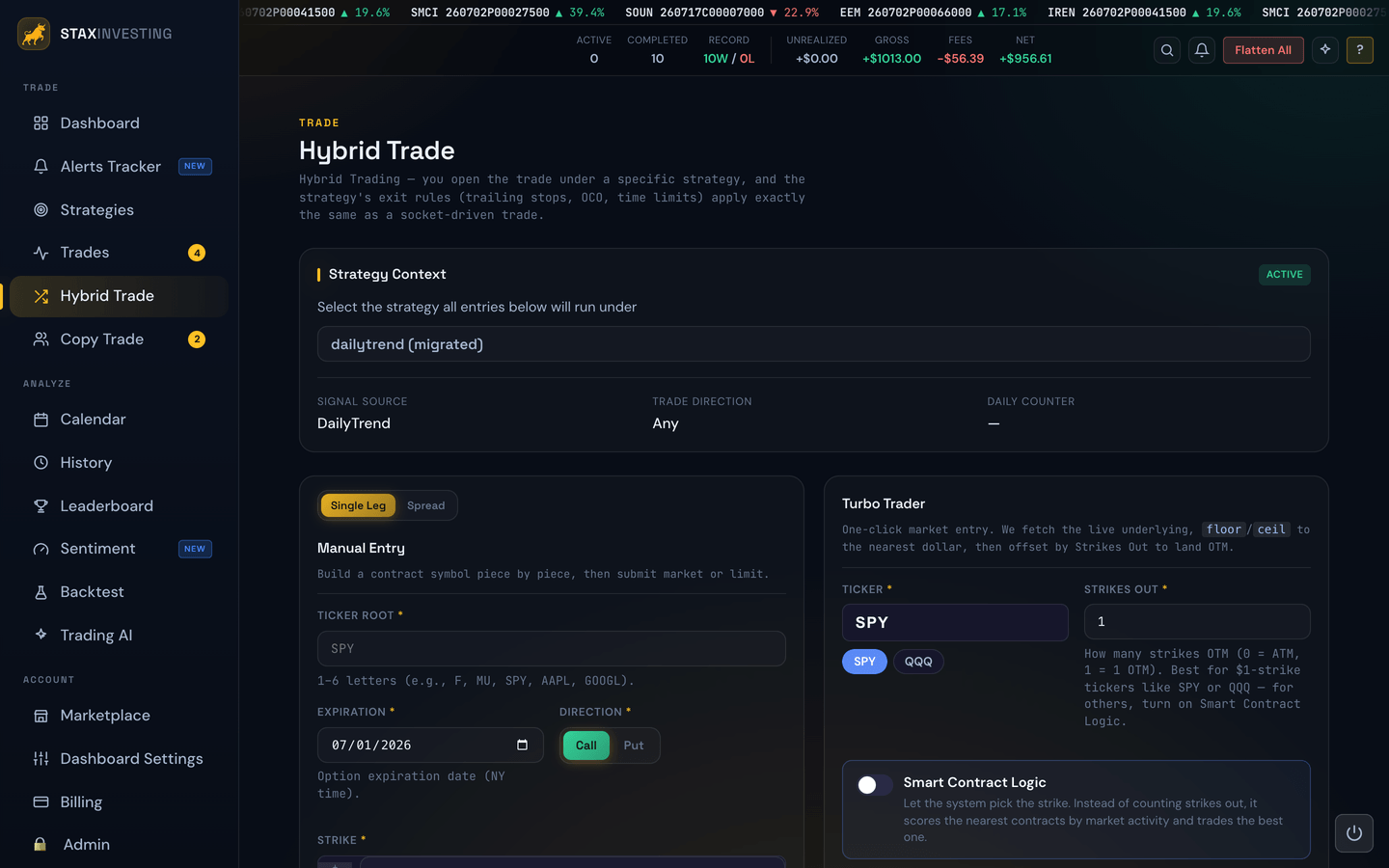
Hybrid Trade is for entering a position by hand while still letting one of your strategies handle the exit. You pick the ticker, the strike, and the direction; the strategy you choose then watches the trade and applies its profit target, stop-loss, trailing stop, and time limits — just as if an alert had brought the trade in.
When to use it
- You're watching a setup the alerts didn't catch and you want to take it.
- You're testing a discretionary idea but you want disciplined automated exits on it.
- You want to add a position alongside the automated ones without abandoning your exit rules.
The form
The entry form asks for the basics:
- Ticker — e.g. SPY, QQQ.
- Expiration — which expiry to use.
- Strike — the strike price.
- Call or Put — direction.
- Quantity — how many contracts.
- Order type — Market (fills right away) or Limit (waits until your price is hit).
- Strategy — which strategy's exit rules should govern this trade after it fills.
Example
You see SPY pulling back to a level you like. You select SPY, the next expiry, the at-the-money call, 1 contract, Market, and assign it to your conservative strategy. The trade opens, and from that point forward it lives by your conservative strategy's stop-loss, profit target, and time-limit rules.
Single Leg or Spread
At the top of the entry form is a Single Leg / Spread switch.
- Single Leg is the standard entry above — one call or one put.
- Spread lets you open a multi-leg options position (like a credit spread or an iron condor) as a single order, all under the strategy you picked.
When you choose Spread, pick the spread type first and the form locks the legs into the correct shape for you — you just fill in the strikes, one shared expiration, the net price, and how many contracts. You enter the net price as a positive number; whether that's money you collect (a credit) or money you pay (a debit) is decided by the spread type, not by a plus or minus sign.
Example
You want to sell a SPY bull put credit spread. Choose Spread, pick Bull Put Credit Spread, enter SPY and this Friday's expiration, set the short put strike to $610 and the long put strike to $605, type 1.20 for the net credit, and 2 contracts. Submitting sends the whole two-leg order at once, and your chosen strategy then manages the exit on the spread as a package.
Note
The Spread option appears when your account is set up to trade spreads — normally when you're trading on a live broker. If you don't see it, you'll just use the Single Leg form. See Spread Trades for how open spreads are displayed and managed once they fill.
Turbo Trader
Below the main entry form is Turbo Trader — a faster, one-click way to open a position at the current market price. Instead of filling in an expiration and a strike, you type a ticker and press GO LONG (buy a call) or GO SHORT (buy a put). Turbo Trader fetches the live price, picks the contract, and sends a market order under the strategy you selected — all in one tap.
Type any ticker into the box, or tap one of the SPY / QQQ quick buttons to fill it in instantly.
There are two ways Turbo Trader decides which strike to buy:
Strikes Out (the default). You tell it how far out-of-the-money to go. 0 is the strike nearest the current price (at-the-money), 1 is one strike further out, and so on. This works best on tickers whose strikes are spaced $1 apart, like SPY and QQQ.
Example
SPY is trading at $613.70. You type SPY, leave Strikes Out at 1, and press GO LONG. Turbo Trader buys the $614 call at the market. Pressing GO SHORT instead would buy the $613 put.
Smart Contract Logic. Flip on the Smart Contract Logic switch and the Strikes Out box disappears — you no longer choose the strike. Instead, when you press GO LONG or GO SHORT, the system looks at the several nearest strikes in your chosen direction and picks the one with the best market activity (things like trading volume and open interest) for you. Use this when you know the ticker and which way you want to trade, but you'd rather let the system pick the exact contract — especially on tickers other than SPY and QQQ, where choosing a strike by hand is harder.
Example
You want to go long NVDA but you're not sure which strike to buy. Type NVDA, turn on Smart Contract Logic, and press GO LONG. The system scans the closest call strikes above NVDA's current price and buys the one with the strongest market activity, then manages the exit under your chosen strategy.
Note
Smart Contract Logic needs live market data to make its choice. If the market is closed for new entries, or the ticker's options are too thinly traded to pick from, Turbo Trader tells you it couldn't find a contract rather than guessing — it never quietly buys a different strike than you intended. If it has to settle for the middle strike because data was thin, it says so after the trade opens.
Warning
Turbo Trader always sends a market order — it fills right away at the current price. Make sure the ticker and direction are right before you press GO.
Today's alerts feed
The page also shows the alerts that have come in today so you can see what your subscriptions are picking up and decide whether to piggyback on one of them manually.
The strategy context banner
At the top of the page is a banner that names the strategy your next entry will run under. Once you've picked a strategy from the dropdown, the banner summarizes:
- The signal source the strategy is wired to (so you know which alert feed it would normally take trades from).
- The trade direction the strategy is configured for (calls, puts, spreads, etc.).
- The daily counter — how many trades the strategy has already taken today out of its daily cap, and how many remain. If the counter is already at its limit, Hybrid Trade will refuse the entry until tomorrow.
This banner is the "you-are-here" reminder for hybrid trading: every entry below it inherits the rules of the strategy named above it.
Set a default strategy
Once you've picked a strategy, tick Make this my default strategy next to the dropdown. From then on, every time you open Hybrid Trade that strategy is selected for you automatically and the entry forms are ready to go — you don't have to choose from the dropdown first. Untick the box to go back to choosing each time.
Example
You almost always hybrid-trade under your "SPY Scalper" strategy. Select it once, tick the box, and tomorrow the page opens straight to SPY Scalper with the Manual Entry and Turbo Trader forms already showing.
Tip
If your default strategy is later disabled or has Allow Manual Entry turned off, the page simply asks you to pick a strategy again — nothing breaks.
A note on responsibility
Hybrid trades are real trades on your real broker account. Once you click submit, the order is sent. Double-check ticker, strike, quantity, and direction before confirming.